

Roof Valley Leaks and the Open and Closed Valley Difference
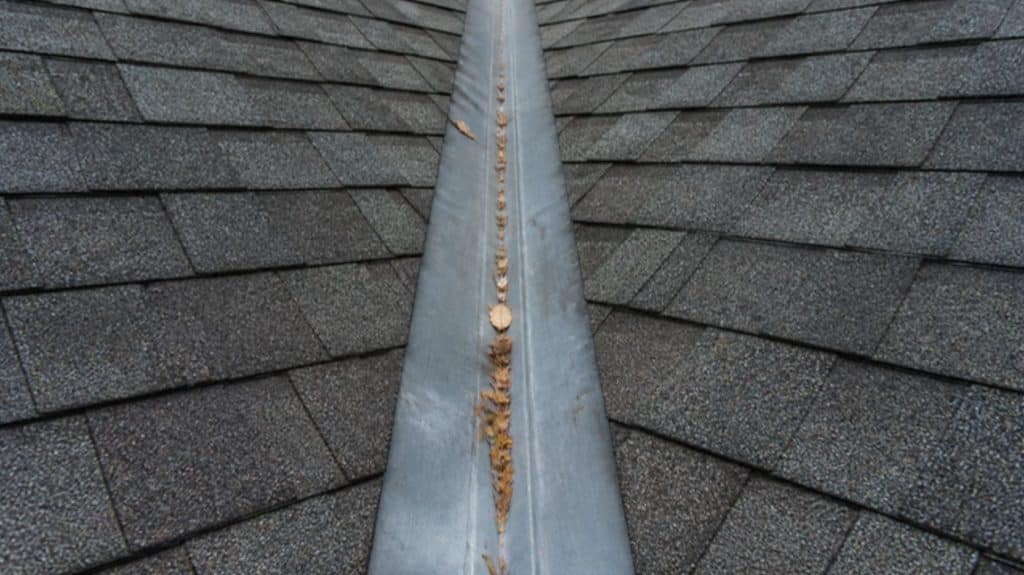
A roof valley is the line where two roof planes meet and run downhill together. Every drop that lands on either plane funnels into that line, which is why valleys leak more often than any flat stretch of roof.
Below is how valleys are built, the difference between open and closed styles, and what makes one fail. TurnKey Roofers repairs valley leaks across the New Orleans area, and the contact page or (504) 732-0336 will get you to us.
Valleys are also the slipperiest part of a roof, since they collect water, leaves and grit. Checking one means standing in the exact spot with the least footing, so that inspection belongs to a crew with fall protection.
Key takeaways
- A valley carries the runoff from two planes at once, so the water volume there is higher than anywhere else on the roof.
- The three basic styles are woven, open and closed cut, plus the California variations of the last two.
- NRCA does not recommend woven valleys, citing debris accumulation, ice buildup and material bridging.
- The code requires open valley metal lining to be at least 24 inches wide, and NRCA adds a center rib at least 1 inch high.
- Fasteners belong at least 8 inches back from the valley centerline, and NRCA recommends valley metal in lengths no longer than 10 feet.
- Most valley leaks trace to nails in the wrong place, undersized lining, or debris damming the channel.
What makes a valley the hardest part of a roof
Water accelerates as it runs down a slope, and where two slopes converge the flow doubles up and speeds through a narrow channel. A valley on a large roof can move more water in a squall than a downspout.
That flow also carries debris. Oak leaves, pine straw and shingle granules all collect in the valley line, and once a dam forms the water backs up and spreads sideways under the shingles.
Wind driven rain adds the other failure mode. Water pushed uphill in a valley gets behind the shingle edges on either side, which is why every valley detail is about keeping the edges sealed and the channel clear.
Our guide to identifying and fixing common roof leaks covers how a valley leak gets separated from a flashing leak or a penetration leak.
The three valley styles
Open valley
An open valley has a metal lining running down the centerline, with shingles from both planes held back from it. The result is a clear metal channel you can see from the ground.
NRCA recommends that metal be formed with a center rib at least 1 inch high, made 24 inches wide, and installed in lengths no longer than 10 feet so thermal movement doesn’t buckle it. The rib keeps water arriving from one plane from shooting across and up under the shingles on the other side.
The open style drains fastest and sheds debris best, which matters under heavy tree cover. It costs more because the metal is a separate material and a separate labor step.
Closed cut valley
In a closed cut valley the shingles from one plane run across the valley and continue onto the other side. Shingles from the second plane are then run up to the valley and trimmed a couple of inches off the centerline.
There’s no exposed metal, so the roof reads as a continuous shingle surface. Lining still goes underneath, and the detailing rules get stricter because the shingles themselves are carrying the water.
The critical rule is fastener placement. NRCA calls for fasteners a minimum of 8 inches back from the centerline, and a nail closer than that sits in the path of the heaviest flow on the roof.
Woven valley
A woven valley alternates shingle courses from both planes across the centerline, interlacing them. It was common for decades and it’s still seen on older New Orleans roofs.
NRCA does not recommend it. The stated reasons are debris accumulation, snow and ice buildup, and material bridging, which is the shingle spanning the valley line without lying flat against the deck underneath.
Bridging is the part that bites. A shingle that isn’t supported in the valley cracks along the fold under foot traffic or over years of thermal cycling.
Comparing the three side by side
| Feature | Open valley | Closed cut valley | Woven valley |
|---|---|---|---|
| Visible finish | Metal channel | Continuous shingle | Continuous shingle |
| Debris shedding | Best | Moderate | Worst |
| Material cost | Highest | Moderate | Lowest |
| Labor | Extra metal step | Careful cutting and nailing | Weaving both planes |
| NRCA position | Recognized | Recognized | Not recommended |
| Common failure | Undersized or short lapped metal | Fasteners too close to centerline | Cracking where shingles bridge |
For a Gulf Coast roof under trees, the open valley usually wins on maintenance. For a roof where appearance drives the decision, a properly detailed closed cut valley performs well.
What the code requires in a valley
The residential code adopted in Louisiana sets minimums for valley lining, and they’re worth knowing because undersized lining is a common shortcut.
- Metal valley lining. Not less than 24 inches wide.
- Mineral surfaced roll roofing lining. A bottom layer of 18 inches with a top layer not less than 36 inches wide.
- Underlayment beneath it. NRCA recommends a full width sheet at least 36 inches wide, favoring a polymer modified bitumen or self adhering sheet in the valley.
- Overlap from the adjacent planes. NRCA puts the material from each roof plane at least 6 inches over the valley base.
- Slope limits on California valleys. NRCA advises against using that variation on slopes below 4:12.
Those numbers exist because the valley is the one place where the water has nowhere else to go. A narrow lining moves the edge of the protection into the wetted path.
Why valleys leak
- Nails in the channel. The single most common cause. Every fastener within a few inches of the centerline sits in running water.
- Lining that’s too narrow. A 16 inch piece of metal in place of a 24 inch one leaves the shingle edges inside the flow.
- Short laps in the metal. Where two lengths meet, the upper piece has to lap well over the lower one, and a reversed or short lap channels water underneath.
- Debris dams. Leaf litter at a valley outlet backs water up the channel and sideways under the courses.
- Bridged shingles. Material that spans the valley without support cracks, usually along the fold line.
- Valley meeting a wall. Where a valley terminates at a sidewall or a dormer, the transition needs its own flashing detail and it’s frequently improvised.
- Tie-ins to an addition. Valleys created where a newer roof meets an older one often lack the underlayment that should run continuously beneath.
Valley metal choice adds one more variable. Galvanized steel is the common default, copper lasts longest and costs the most, and aluminum sits between them but dents easily under a ladder.
Whatever the metal, it should never be fastened through the middle of the channel. Fasteners go at the outer edges, with clips or cleats where the detail calls for them, so nothing penetrates the wetted path.
Most of those are workmanship, which is the good news. They can be corrected without replacing the whole roof if the covering still has life in it.
How a valley repair actually goes
- Find the real entry point. Water in a valley runs a long way before it shows, so the stain inside rarely sits under the hole.
- Open the valley. Shingles on both sides are lifted back far enough to expose the lining and the underlayment.
- Inspect the deck. Valleys stay wet longest, so sheathing damage is more likely here than anywhere else on the roof.
- Replace the underlayment. A full width self adhering sheet goes down the valley line first, lapped by the field underlayment on both sides.
- Set new lining. Metal at full width, lapped correctly and fastened only at the outer edges, in manageable lengths.
- Re-lay the shingles. Cut back from the centerline for an open valley, or trimmed and held clear of the flow for a closed cut, with fasteners kept well back.
- Seal the cut edges. On a closed cut valley the trimmed edge gets a bead of roofing cement so wind driven water can’t get under it.
The roof flashing repair page covers this work alongside the other metal details, and the roof repair page covers how a valley job gets scoped against the age of the roof.
Frequently asked questions
What is the valley of a roof?
It’s the internal angle formed where two sloping roof planes meet and run downward together. Rain from both planes drains into that line and travels down it to the eave. Because of the concentrated flow, the valley needs its own lining and underlayment underneath the shingles.
Which is better, an open valley or a closed valley on a roof?
Open valleys drain faster and shed leaves better, which is an advantage on a shaded New Orleans lot. Closed cut valleys look cleaner and cost less, and they perform well when the fasteners are kept at least 8 inches from the centerline and the lining is full width. Woven valleys are the one style NRCA advises against.
How to do valleys on shingles?
Start with a full width underlayment sheet down the valley line, at least 36 inches wide, with the field underlayment lapped over it from both planes. Add the lining, which the code sets at 24 inches minimum for metal. Then run the shingles, holding all fasteners well back from the centerline and sealing any cut edges.
How long does a roof valley last?
A correctly built valley lasts as long as the roof covering around it. A valley with nails in the channel or undersized lining can start leaking within a few years, which is why valley leaks show up on roofs that otherwise look fine. Metal choice matters too, since the lining sees more water than any other component.
Can a valley be repaired without replacing the roof?
Usually yes, as long as the shingles are still flexible enough to lift without cracking. The repair involves opening the valley, renewing the underlayment and lining, and re-laying the courses on both sides. On a brittle older roof, the lifting causes enough breakage that replacing the slope becomes the better call.
Get the valley looked at before the next heavy rain
Valleys carry the most water and get the least attention. A leak there usually means a detail was wrong from day one, and it won’t fix itself.
TurnKey Roofers will inspect the valleys, find where the water is entering, and give you a free estimate on the repair. Call (504) 732-0336 or reach us through the site.
Related reading
- How to tell if your roofing job was done poorly
- Roof maintenance myths debunked
- How to extend the lifespan of your roof
Sources
Common questions about working with us
Yes we do, we offer 50 year non pro-rated warranty and 10 year workmanship warranty. We also offer 15 year unlimited wind warranty even from a named storm.
Turnkey roof repair is a comprehensive service where the entire roof repair process is managed from start to finish by a single provider. This includes assessment, planning, execution, and final inspection.
The TurnKey process includes a thorough roof inspection, detailed project planning, sourcing of materials, execution of repairs, and a final inspection to ensure quality and client satisfaction.
The duration varies based on the extent of damage and the size of the project. A professional assessment will provide a more accurate timeline.
Look out for signs such as leaks, missing or damaged shingles, sagging areas, or visible water damage in your ceiling. If you’re unsure, a professional assessment is recommended.
We work across New Orleans and 13 more communities: Metairie, Kenner, Harahan, River Ridge, St. Rose, Gretna, LaPlace, Covington, Mandeville, Madisonville, Slidell, Hammond and Baton Rouge. Call 504-732-0336 and we’ll confirm we cover your street.
Yes. Our 15-year unlimited wind warranty applies even when the damage comes from a named storm. It sits alongside our 50-year non-prorated warranty and 10-year workmanship warranty.
It depends on the size and pitch of the roof, the material you choose, and whether any decking or flashing needs replacing. After a free roof inspection, we give you a plan and a quote. For a breakdown by material and roof size, read our guide to roof replacement cost in New Orleans.