

TPO Roofing Membrane Installation on Low Slope Commercial Roofs
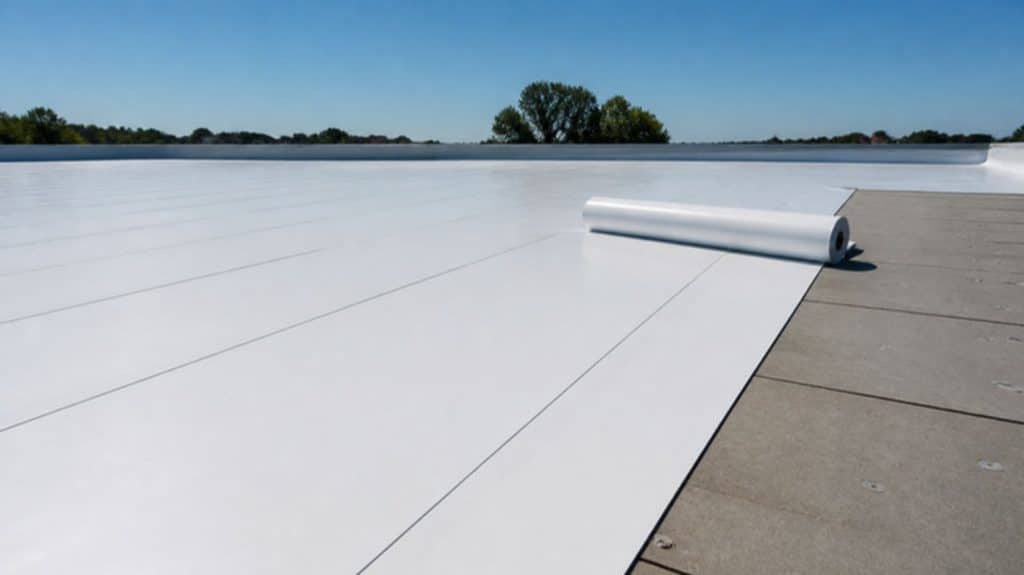
TPO stands for thermoplastic polyolefin, and it’s the white single ply sheet you see on most newer low slope commercial roofs. The defining feature is the seam, which is welded with hot air rather than glued.
Here’s how a TPO roof is built, what the attachment options mean for your building, and what the code and the test standards require. TurnKey Roofers installs and repairs these systems around New Orleans, and the contact page or (504) 732-0336 will reach the office.
Low slope roofs feel walkable and that’s the trap. Unguarded edges, skylights and hatches are all fall hazards, so leave the survey to a crew that works with fall protection.

Key takeaways
- TPO carries a reinforcement layer of polyester or fiberglass added during manufacturing, which is what gives the sheet its tear strength.
- ASTM D6878 is the governing specification, first published in 2003 and tightened repeatedly since.
- Seams are hot air welded, producing a continuous bond rather than an adhesive joint.
- Attachment can be by mechanical fasteners, bonding adhesive, induction welding or ballast, and the choice changes the whole system design.
- Carlisle’s Sure-Weld EXTRA is an 80 mil sheet, and thickness is the main lever on long term weatherability.
- Wind performance is proven by test standard, with FM 4474, UL 580 and UL 1897 named in the code and ANSI/SPRI ES-1 covering the perimeter edge.
What TPO actually is
TPO is a thermoplastic membrane, which means heat softens it and it returns to its original state when it cools. That’s the property the whole system is built around.
The sheet carries a reinforcement scrim, either polyester or fiberglass, built in during manufacturing. The compounded material is heated to a high temperature to allow the forming process, and the scrim goes in as part of that.
ASTM D6878, the standard specification for thermoplastic polyolefin based sheet roofing, was first published in 2003 and has been updated with increasingly stringent requirements since. A membrane that meets the current version is a meaningfully different product from an early one.
NRCA’s account of the material lists its working properties: long term weathering resistance, cold temperature flexibility, tear resistance, puncture resistance, chemical resistance and heat seaming, plus resistance to standing water and freeze thaw cycling.
Why the welded seam matters
On a thermoset membrane like EPDM, seams are sealed with adhesives and tape. The bond is only as good as the surface preparation on the day.
Thermoplastic sheets are different. Because they return to their normal configuration when heat is applied, the seams can be melded together with hot air welding, which fuses the two sheets into one piece of material.
That has two practical consequences. A welded seam doesn’t have a separate adhesive to fail, and a repair years later welds to the existing sheet instead of relying on a patch adhesive.
Weld quality is the variable. Welder temperature, speed and roller pressure all have to suit the membrane thickness and the ambient conditions, which is why manufacturers publish welding guides and why crews run test welds and probe seams.
The four ways TPO gets attached
Mechanically attached
Plates and fasteners hold the sheet down along the seam lines, and the next sheet laps over and welds on top. It’s the fastest and usually the cheapest method.
The tradeoff is flutter. The sheet balloons between fastener rows in high wind, so the fastening pattern has to be designed for the building’s wind zone, with tighter spacing at the corners and perimeter.
Fully adhered
The membrane is bonded to the substrate across its full area with adhesive. There’s no flutter, the surface stays flat, and the system generally performs better under uplift.
It costs more in material and labor, and the substrate has to be clean and dry for the adhesive to bond. That’s a real scheduling constraint in a Gulf Coast summer.
Induction welded
Fasteners with coated plates are installed through the insulation, then an induction tool heats each plate through the membrane so the sheet bonds to it. You get much of the uplift performance of a fully adhered system without the adhesive.
It also means fewer fasteners penetrating the sheet itself, since the plates sit under the membrane rather than through it.
Ballasted
The membrane is loose laid and held down by stone ballast or pavers. It’s uncommon on new commercial work in hurricane country, because ballast becomes projectile material in extreme wind.
Comparing the attachment methods
| Method | Uplift performance | Relative cost | Main constraint |
|---|---|---|---|
| Mechanically attached | Good with a designed pattern | Lowest | Sheet flutter in high wind |
| Fully adhered | Strong | Highest | Needs a clean, dry substrate |
| Induction welded | Strong | Between the two | Requires the specific plate system |
| Ballasted | Dependent on ballast staying put | Low material cost | Poor fit for coastal wind zones |
Corner and perimeter zones get tighter fastening on every one of these methods. Uplift pressure is highest at the edges and corners of a roof, so a pattern that’s adequate in the field is not adequate at the parapet.
The insulation attachment underneath matters as much as the membrane attachment. A sheet fastened correctly to boards that are themselves loose will lift as an assembly, taking the insulation with it.
Membrane thickness is the other lever. Carlisle’s Sure-Weld line runs to an 80 mil sheet marketed for the longest term performance and weatherability, and the company also offers a high slope formulation aimed at specific fire code approvals.
How a TPO roof goes on
- Survey and moisture scan. Core cuts and a scan establish whether the existing insulation is wet, which decides between a tear off and a re-cover.
- Tear off or prepare the substrate. Failed material comes off, and the deck gets inspected and repaired before anything new goes down.
- Insulation and cover board. Boards are laid in the specified pattern, with a cover board giving the membrane a firm, even surface.
- Build the slope where needed. Tapered insulation and crickets correct low spots so water reaches the drains instead of sitting.
- Attach the membrane. Mechanically fastened, adhered or induction welded per the specification, with the fastening pattern tightened at corners and perimeter.
- Weld the seams. Automatic welders run the long laps, hand welders handle details, and seams are probed to check the bond.
- Detail the penetrations. Pipe boots, curbs, drains and equipment supports each get their own flashing, welded rather than taped.
- Terminate the edges. Perimeter edge metal and coping go on to a tested edge system, which is where uplift concentrates.
Our commercial roof installation page covers how that sequence gets scoped, and the re-roofing page covers what changes when there’s an existing assembly to deal with.
What the code and the test standards require
A membrane roof is approved as an assembly, not as a product in isolation.
- Fire classification. Table 1505.1 sets a minimum Class B roof covering for most commercial construction types, with Class C permitted on certain construction where there’s a fire separation distance of at least 10 feet.
- Wind uplift testing. The code references FM 4474, UL 580 and UL 1897 for built up and single ply membrane assemblies.
- Edge systems. ANSI/SPRI ES-1 governs perimeter edge metal, which is a frequent failure point on coastal buildings.
- Ballasted systems. ANSI/SPRI RP-4 applies where the roof is held down by ballast.
- Secondary drainage. Where the perimeter can trap water, overflow drains or scuppers are required, with scupper openings of at least 4 inches.
The drainage requirement matters more than it sounds. A TPO membrane tolerates standing water, and the structure underneath is what’s actually at risk when a drain blocks.
Living with a TPO roof in New Orleans
TPO earns its place here on surface temperature. A light colored membrane reflects far more sunlight than a dark one, which shows up on a building that runs cooling most of the year.
Maintenance is light but not optional. Clear the drains and scuppers each season, walk the seams and details once or twice a year, and put down walkway pads on any route service technicians use.
Repairs are the easy part. A TPO patch welds to the original sheet, so a puncture from a dropped tool is a fast fix as long as it’s found before water tracks into the insulation.
The flat roof page covers where TPO sits against the other low slope options we install.
Frequently asked questions
How long does a TPO roof last?
Service life tracks membrane thickness, attachment method, detailing quality and drainage more than brand. TPO weathers from ultraviolet light and heat like any membrane, and manufacturers run accelerated aging tests to demonstrate performance beyond what the standard requires. A thicker sheet on a roof that drains properly and gets its details maintained lasts considerably longer than a thin one on a ponding roof.
What thickness of TPO should I use?
Thicker sheets carry more material above the reinforcement scrim, which is what weathers away over time. Carlisle markets its 80 mil Sure-Weld EXTRA for the longest term performance and weatherability, and thinner options exist for lighter duty applications. Rooftop traffic and equipment density push the decision toward a thicker membrane.
Can TPO be installed over an existing roof?
Sometimes, and only after a moisture survey. If the existing insulation is dry and the number of existing layers permits it, a re-cover with a new cover board and membrane is often the better value. Wet insulation has to come out, because covering it traps the water against the deck.
Is TPO better than EPDM?
They fail differently rather than one being better everywhere. TPO seams are hot air welded into a continuous bond, while EPDM seams rely on adhesives and tape, and TPO is usually light colored where EPDM is usually dark. EPDM has a long field record and suits large simple roofs, while TPO’s welded details suit roofs with many penetrations.
Does TPO handle standing water?
The membrane itself resists standing water and freeze thaw cycling, which is one of the properties the material is known for. That doesn’t make ponding acceptable, since the weight deflects the deck and deepens the low spot. Design the drainage properly and treat the membrane’s tolerance as a safety margin rather than a plan.
Get a straight read on your low slope roof
TPO is a good system installed well and a mediocre one installed badly, and the difference is in the welds, the fastening pattern and the drainage. None of that shows in a brochure.
TurnKey Roofers will survey your roof, tell you what the assembly needs, and give you a free estimate with the options priced out. Call (504) 732-0336 or reach us through the site.
Related reading
- How to manage a roof upgrade without interrupting your tenants
- How new roofing materials help reduce urban heat in cities
- The link between poor roof design and higher utility bills
Sources
Common questions about working with us
Yes we do, we offer 50 year non pro-rated warranty and 10 year workmanship warranty. We also offer 15 year unlimited wind warranty even from a named storm.
Turnkey roof repair is a comprehensive service where the entire roof repair process is managed from start to finish by a single provider. This includes assessment, planning, execution, and final inspection.
The TurnKey process includes a thorough roof inspection, detailed project planning, sourcing of materials, execution of repairs, and a final inspection to ensure quality and client satisfaction.
The duration varies based on the extent of damage and the size of the project. A professional assessment will provide a more accurate timeline.
Look out for signs such as leaks, missing or damaged shingles, sagging areas, or visible water damage in your ceiling. If you’re unsure, a professional assessment is recommended.
We work across New Orleans and 13 more communities: Metairie, Kenner, Harahan, River Ridge, St. Rose, Gretna, LaPlace, Covington, Mandeville, Madisonville, Slidell, Hammond and Baton Rouge. Call 504-732-0336 and we’ll confirm we cover your street.
Yes. Our 15-year unlimited wind warranty applies even when the damage comes from a named storm. It sits alongside our 50-year non-prorated warranty and 10-year workmanship warranty.
It depends on the size and pitch of the roof, the material you choose, and whether any decking or flashing needs replacing. After a free roof inspection, we give you a plan and a quote. For a breakdown by material and roof size, read our guide to roof replacement cost in New Orleans.