
Modified Bitumen Roofing Layers and Typical Service Life
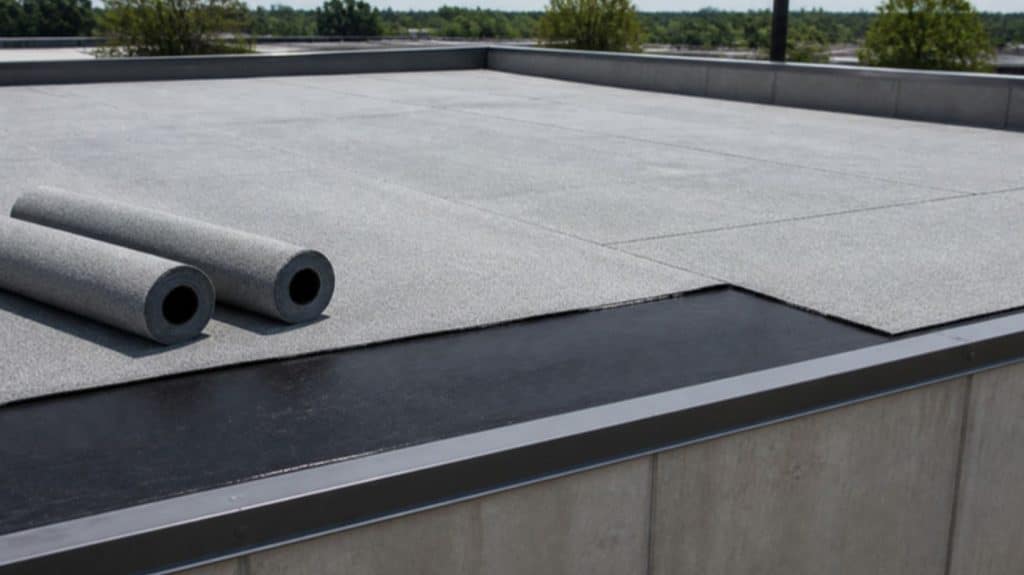
A modified bitumen roof is asphalt sheet goods, unrolled in layers and bonded down over a flat or low slope deck. Around New Orleans you’ll find it on corner stores, small offices, rear additions and porch roofs that are too flat for shingles.
The two things owners ask us first are how many layers the roof needs and how long those layers will last. The short answer on layers is two at minimum, a base sheet and a cap sheet, and the cap is the one carrying the granules you can see from the ground. For the second question, HomeGuide’s cost research puts the average modified bitumen roof at 10 to 20 years, with installation quality and maintenance moving it inside that band.
The rest of this page walks through what each ply does, how SBS and APP differ, and what the code requires for slope. If you want a set of eyes on your own roof, TurnKey Roofers works across the metro area. Send the details through our contact page or call (504) 732-0336.

Key takeaways
- Modified bitumen is asphalt reinforced with polymer and a fabric mat, sold in rolls and installed in plies rather than as one poured surface.
- A standard system is a base sheet plus a granule surfaced cap sheet, and a third ply adds redundancy on roofs that take foot traffic.
- SBS is the rubber modified version with better stretch and recovery. APP is the plastic modified version with stronger heat and ultraviolet resistance.
- Building code sets a design slope of at least 1/4 inch of fall per foot so water leaves the roof instead of sitting on the seams.
- HomeGuide puts installed cost at $4.00 to $7.50 per square foot and typical service life at 10 to 20 years.
- Standing water, torn seams and bare spots where granules washed off are the three findings that shorten the roof the most.
What the layers actually are
Modified bitumen starts as asphalt, the same base material in a shingle. Manufacturers blend a polymer into it so the sheet stays flexible in cold weather and holds its shape in heat, then run that blend onto a reinforcing mat.
Polyglass describes its membranes as reinforced with polyester, fiberglass, or a combination of the two, which is what gives the sheet its tensile strength and puncture resistance. The mat is the skeleton. The asphalt blend is the waterproofing.
The base sheet
The base sheet goes down first, directly on the deck or on top of insulation board. It can be mechanically fastened with plates and screws, set in hot asphalt, laid in cold adhesive, or self adhered with a peel and stick back.
This ply does the structural work of holding the assembly to the building. It isn’t meant to be exposed to sun for long, so a base sheet left uncovered over a weekend is a job that got interrupted, not a finished roof.
The cap sheet
The cap sheet is the top ply and the one that takes weather. Polyglass surfaces its cap sheets with granules for ultraviolet protection, the same reason shingles carry granules.
Cap sheets come in white and light colors as well as the traditional black and gray. The EPA lists asphaltic membranes with reflective granules among the cool roof options for flat and gently sloping commercial roofs, so the color you pick changes how much heat the assembly takes on through a Louisiana August.
The optional middle ply
Some specifications call for an interply between the base and the cap. That third layer buys redundancy, which the Asphalt Roofing Manufacturers Association names as one of the defining traits of asphalt based low slope systems.
Three ply assemblies cost more and take longer. They earn their keep on roofs that carry HVAC units, service techs and anything else that puts boots on the membrane every month.
SBS and APP are not interchangeable
Both are modified bitumen. The modifier is the difference, and it decides how the sheet behaves and how it can be installed.
| Trait | SBS | APP |
|---|---|---|
| Modifier | Styrene butadiene styrene, a synthetic rubber | Atactic polypropylene, a plastic |
| Behavior | Elongation and recovery across a wide temperature range, per ARMA | Higher resistance to ultraviolet light and flexibility at temperature extremes, per ARMA |
| Best suited to | Decks that move or deflect | Sun exposed roofs in hot climates |
| Install methods | Self adhered, torch applied, cold process, hot asphalt, mechanically attached | Self adhered or torch applied |
ARMA notes that the elongation and recovery of SBS make it a fit where a deck moves or deflects under load. On a wood framed New Orleans building that flexes, that stretch matters.
APP holds up to sun. HomeGuide’s material summary describes APP as suited to sunny, humid climates and SBS as the better performer in the cold, which lines up with what the two polymers do.
How the plies go down
Installation method drives both the labor cost and the risk on site. HomeGuide puts installation labor at $2.30 to $4.00 per square foot depending on which method the crew uses.
- Deck prep. The old roof comes off or gets covered per the specification, wet insulation is cut out, and the deck gets checked for soft spots and fastener pull.
- Base sheet. The first ply is fastened, mopped, adhered or peeled and stuck, run parallel to the low edge so laps shed water.
- Flashing and details. Curbs, drains, pipes and wall terminations get their own reinforcing plies before the field is closed in.
- Cap sheet. The granulated top ply is set with side and end laps staggered off the base sheet laps, never stacked over them.
- Seam check. The crew probes every lap with a trowel or seam tool and reheats or re-adheres anything that opens.
Torch application uses open flame against asphalt over a combustible deck. That’s the method behind most roofing fires, and it’s the reason self adhered sheets have taken so much of the market.
What the code requires for slope
Flat roofs aren’t flat. Building code requires modified bitumen roofing to have a design slope of not less than 1/4 unit vertical in 12 units horizontal, a 2 percent slope, for drainage.
That works out to a quarter inch of fall for every foot of run. On a 30 foot deep building, the high side sits about 7.5 inches above the drain edge.
The code also names the material standards a membrane has to meet: ASTM D6162, D6163, D6164, D6222, D6223, D6298 or D6509, with base sheets meeting ASTM D1970 or D4601. If a bid doesn’t name a standard or a specific manufacturer’s system, ask which one the material meets.
Typical service life and what eats into it
HomeGuide reports that modified bitumen roofs last 10 to 20 years on average, and that routine maintenance and quality installation push the number up. ARMA frames longevity the same way, listing roof system design, job specifications, material quality, application procedures and maintenance as the factors that decide it.
Here’s what we find on the roofs that fail early in this climate:
- Ponding water. Water still standing 48 hours after rain means the slope or the drain isn’t doing its job. Seams sitting in water are the first to open.
- Bare, shiny patches. Granules wash into the gutter over time. Once the asphalt is exposed, sun does the rest.
- Open laps. A lap that lifts at the edge will take water under the cap sheet. These are cheap to fix in year six and expensive to ignore until year ten.
- Blisters. Trapped moisture or air between plies expands in heat. Small ones can be monitored, large ones get cut, dried and patched.
- Failed flashing. Wall terminations, curbs and pipe boots move on a different schedule than the field membrane and usually let go first.
- Traffic damage. Every service call on a rooftop unit is a chance for a dropped tool or a dragged ladder to cut the cap sheet.
Two inspections a year catches most of this. Spring and late fall work well here, so you go into hurricane season and then into the wet winter with the roof already checked.
What it costs to put one on
HomeGuide’s figures put installed modified bitumen at $4.00 to $7.50 per square foot, with an average total of $4,900 to $14,600. Material and supplies run $0.70 to $2.20 per square foot in that same breakdown, and removing the old roof adds $1.00 to $1.30 per square foot.
Rolls are priced by the square. HomeGuide lists $150 to $560 per roll, with each roll covering roughly 100 square feet, and the spread comes down to brand, polymer and surfacing.
Those are national figures, not a quote from us. What a specific roof costs depends on how much tear off it needs, how the crew gets material to the roof, and how many curbs and drains have to be flashed.
Repair, recover or replace
A membrane with isolated damage and sound insulation underneath is usually a repair. Cut out the section, build it back with matching plies, and keep the rest of the roof’s life.
A roof that’s dry under the membrane but worn out on top can sometimes take a new layer instead of a tear off. That’s the call we make on commercial re-roofing projects after a moisture survey, not from the ground.
Wet insulation changes everything. Once water is in the board, it stays there, and the only fix that lasts is removal down to the deck and a new roof installation built back up in plies.
Staying off the roof yourself
A low slope roof feels safe to walk. It isn’t, especially when the membrane is wet, when granules act like ball bearings underfoot, or when the edge has no parapet.
OSHA requires fall protection for roofing work on low slope roofs with unprotected sides and edges 6 feet or more above a lower level. That’s the standard professional crews work under, and it’s a fair line for a homeowner to respect too.
Check what you can from a ladder at the edge or from an upstairs window. If the answer needs someone standing in the middle of the roof, that’s a call for a roofer with harnesses and anchors.
Frequently asked questions
How many layers does a modified bitumen roof need?
Two plies is the working minimum: a base sheet for attachment and a granulated cap sheet for weather. A third interply is specified where the roof takes regular foot traffic or where the owner wants extra redundancy, which ARMA names as a defining trait of asphalt based low slope systems.
Is torch down the same as modified bitumen?
Torch down is one way to install modified bitumen, not a separate material. Polyglass lists heat welded and torch applied alongside self adhered, cold process, hot asphalt and mechanically attached methods for its membranes, and self adhered sheets avoid open flame on the deck entirely.
Can modified bitumen go on a pitched roof?
It’s made for low slope and flat decks. Code sets the minimum design slope for modified bitumen at 1/4 unit vertical in 12 units horizontal for drainage, and roofs steeper than about 3 in 12 are shingle, metal, tile or slate territory instead.
How do I know if my flat roof is failing or just dirty?
Dirt and staining sit on top of the granules and don’t change the surface texture. Failure looks like bare asphalt where granules are gone, laps lifting at the edges, soft spots underfoot and water still standing two days after rain.
What does a white cap sheet change?
It changes how much solar heat the roof takes on. The EPA lists asphaltic membranes with reflective granules among cool roof products for low slope buildings, and notes that in buildings without air conditioning, cool roofs can lower maximum indoor temperatures by 2.2 to 5.9 degrees Fahrenheit.
Get your flat roof looked at before the next storm season
If your building has a low slope roof and you don’t know what’s on it or how old it is, that’s worth an hour of someone’s time. We’ll tell you what system is up there, what condition the seams and flashings are in, and whether this is a repair year or a replacement year.
Take a look at our flat roof page for the systems we work with, then reach out through the contact form or call (504) 732-0336 for a free estimate.
Related reading
- Best Roofing Options for New Orleans’ Climate
- How to Extend the Lifespan of Your Roof
- How to Identify and Fix Common Roof Leaks
Sources
- International Building Code 1507.11, Modified bitumen roofing, via UpCodes
- Asphalt Roofing Manufacturers Association, Asphalt-based Low-slope Roof Systems Provide Long-term Service Life
- Polyglass, Modified Bitumen Membranes product literature
- HomeGuide, Modified Bitumen Roof Cost
- US EPA, Using Cool Roofs to Reduce Heat Islands
- OSHA 29 CFR 1926.501, Duty to have fall protection
Common questions about working with us
Yes we do, we offer 50 year non pro-rated warranty and 10 year workmanship warranty. We also offer 15 year unlimited wind warranty even from a named storm.
Turnkey roof repair is a comprehensive service where the entire roof repair process is managed from start to finish by a single provider. This includes assessment, planning, execution, and final inspection.
The TurnKey process includes a thorough roof inspection, detailed project planning, sourcing of materials, execution of repairs, and a final inspection to ensure quality and client satisfaction.
The duration varies based on the extent of damage and the size of the project. A professional assessment will provide a more accurate timeline.
Look out for signs such as leaks, missing or damaged shingles, sagging areas, or visible water damage in your ceiling. If you’re unsure, a professional assessment is recommended.
We work across New Orleans and 13 more communities: Metairie, Kenner, Harahan, River Ridge, St. Rose, Gretna, LaPlace, Covington, Mandeville, Madisonville, Slidell, Hammond and Baton Rouge. Call 504-732-0336 and we’ll confirm we cover your street.
Yes. Our 15-year unlimited wind warranty applies even when the damage comes from a named storm. It sits alongside our 50-year non-prorated warranty and 10-year workmanship warranty.
It depends on the size and pitch of the roof, the material you choose, and whether any decking or flashing needs replacing. After a free roof inspection, we give you a plan and a quote. For a breakdown by material and roof size, read our guide to roof replacement cost in New Orleans.