
Roof Underlayment Options and Why the Layer Under Shingles Matters
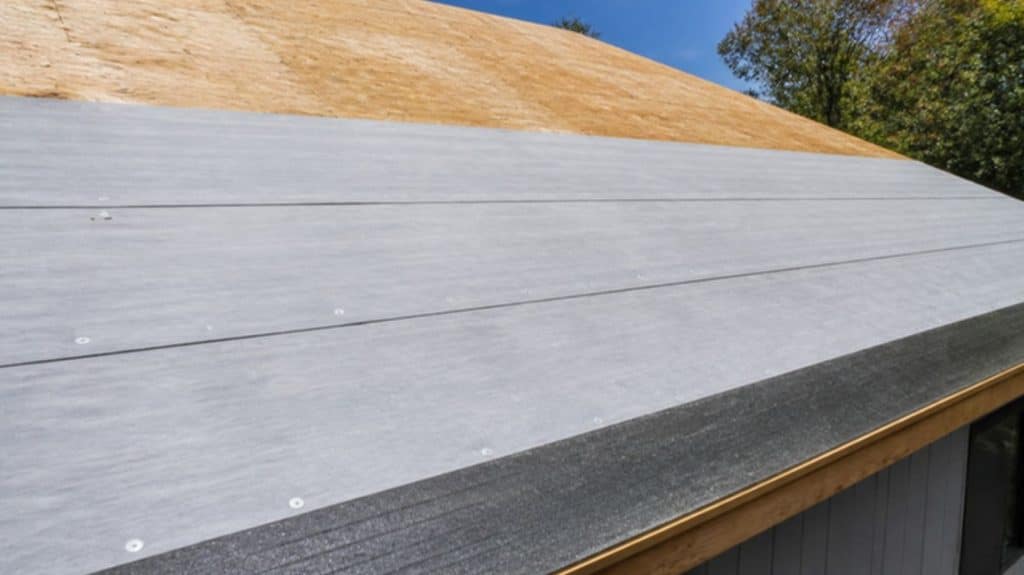
Roof underlayment is the sheet that goes down on the roof deck before the shingles do. You never see it again once the roof is finished, and it’s the layer standing between wind driven rain and your ceiling when a shingle lifts or a tab blows off.
This guide walks through what underlayment does, how felt, synthetic and self adhering products differ, and what the residential code asks for at each roof slope. TurnKey Roofers works on these assemblies across the New Orleans metro area, and you can reach the office through the contact page or at (504) 732-0336.
One note before you read further. Underlayment sits beneath the shingles, so checking it means lifting roofing material on a sloped surface. That’s work for someone with fall protection, not something to try on a Saturday afternoon.

Key takeaways
- Underlayment is a secondary water barrier. Shingles shed most of the water, and the sheet underneath catches what gets past them.
- Asphalt saturated felt is manufactured to ASTM D226 or ASTM D4869, with Type I roughly matching No. 15 felt and Type II matching No. 30, according to the Asphalt Roofing Manufacturers Association.
- Synthetic sheets are lighter, cover more area per roll, and are evaluated under ASTM D8257 or under ICC Evaluation Service acceptance criteria rather than the older felt standards.
- The Louisiana residential code requires a doubled underlayment layer on slopes from 2:12 up to 4:12, and a single lapped layer above that.
- Self adhering polymer modified membranes seal around nail shanks, which is why they show up at eaves, valleys and low slope transitions.
- Underlayment choice interacts with attic ventilation, and on a humid Gulf Coast roof that pairing deserves attention.
What the layer under your shingles is actually doing
Shingles are a water shedding system, not a sealed one. They overlap so gravity carries water down and off the edge, and they do that job well on a dry, calm day.
Wind changes the math. A gust that lifts a shingle tab or drives rain uphill at a seam puts water on the deck, and at that moment the underlayment is the only thing keeping it out of your framing.
The Asphalt Roofing Manufacturers Association lists several jobs for the sheet: secondary water protection, keeping the deck dry during construction before the shingles go on, reducing the pattern of deck joints telegraphing through the finished roof, and separating shingles from resins in the wood below. Fire rated assemblies also count on it, since the classification applies to the whole assembly rather than to the shingle alone.
There’s a practical angle too. Roofs rarely get torn off and re-covered in one clean day, especially in a wet season, and the underlayment is what protects your house overnight between the tear off and the load out.
The three families of roof underlayment
Asphalt saturated felt
Felt is paper or organic mat saturated with asphalt. It has been the default for generations, and it’s still specified constantly because it’s inexpensive and every crew knows how to run it.
ARMA notes that felts fall under ASTM D226 and ASTM D4869, split into Type I and Type II by weight. Type I lines up with what the trade calls No. 15, and Type II with No. 30.
Felt is water resistant rather than waterproof, and it has some vapor permeability, which some designers want on a wood deck. It also tears more easily than a woven sheet, and it doesn’t like long exposure to sun before the shingles cover it.
Synthetic underlayment
Synthetics are woven or spun polypropylene and polyolefin sheets. They weigh far less per square of coverage, so a single roll goes further and fewer roll ends land in the dumpster.
NRCA’s Professional Roofing pointed out that these products weren’t referenced by name in the model codes, so manufacturers worked with the ICC Evaluation Service to develop acceptance criteria AC188 and AC207 as an alternative compliance path. ARMA now also lists ASTM D8257 as the consensus standard covering polymeric underlayments.
Two field advantages matter to a crew. Synthetics hold up longer under sun exposure before the roof covering goes on, and the good ones have a textured walking surface. CertainTeed describes the slip resistant face on its DiamondDeck sheet as footing for installers on steep roofs, which is a safety feature as much as a product feature.
Self adhering polymer modified membranes
These are the peel and stick sheets, made to ASTM D1970. The adhesive backing bonds to the deck, and the rubberized asphalt closes around a nail shank when a fastener goes through it.
ARMA’s guidance flags the tradeoff. A self adhering sheet also acts as a vapor retarder, so covering an entire deck with one makes attic ventilation more important, not less.
That’s a live issue on Gulf Coast houses. Our posts on how New Orleans humidity affects roof decking and on ventilation in humid climates cover why a sealed deck without airflow can trade one problem for another.
Comparing the options side by side
| Type | Governing standard | Typical use | Main tradeoff |
|---|---|---|---|
| No. 15 felt | ASTM D226 Type I or D4869 | General field on steeper slopes | Tears in wind, short exposure window |
| No. 30 felt | ASTM D226 Type II or D4869 | Doubled application, heavier duty field | Heavier rolls, still asphalt based |
| Synthetic sheet | ASTM D8257 or ICC-ES AC188 | Whole roof field on most new work | Costs more per square than felt |
| Self adhering membrane | ASTM D1970 | Eaves, valleys, penetrations, low slope | Vapor retarder, so ventilation matters |
| Inorganic fiber sheet | ASTM D6757 | Dimensionally stable felt alternative | Less common in local supply houses |
What the code requires at each slope
The residential code adopted in Louisiana sets the floor, and it keys the underlayment rule to roof slope. Section R905.2.2 limits asphalt shingles to slopes of 2 units vertical in 12 units horizontal or steeper, which works out to a 17 percent slope.
From there, the requirement splits:
- Slopes of 4:12 and steeper. A single layer of underlayment applied shingle fashion, starting at the eave and running parallel to it, with successive sheets lapped not less than 2 inches.
- Slopes from 2:12 up to 4:12. A doubled layer. The code calls for a 19 inch starter strip parallel with the eave, then 36 inch wide sheets overlapping each other by 19 inches, so every point on the deck has two thicknesses over it.
- Below 2:12. Asphalt shingles aren’t permitted at all, and the roof needs a low slope membrane system instead.
Those are minimums. Manufacturers publish their own installation instructions, and the stronger system warranties often require more than the code floor, so the specification on a given job can be tighter.
How underlayment goes on a re-roof
- Tear off to the deck. Old roofing and old underlayment come off so the sheathing can be seen. Soft or delaminated plywood gets replaced at this stage, not covered over.
- Set the eave protection. Where the specification calls for a self adhering membrane at eaves, rakes or valleys, it goes down first so the field sheets lap over it.
- Run the drip edge at the eave. Drip edge at the eave is installed under the underlayment, while at the rake it goes over the top of it.
- Roll the field. Sheets run parallel to the eave, working up the roof, with laps sized to the slope rule above and cap fasteners spaced per the manufacturer’s pattern.
- Detail the penetrations. Pipe boots, curbs and chimneys get the membrane tucked and sealed before the shingles reach them.
- Cover it promptly. Even a synthetic with a long exposure rating performs best when the shingles go down soon after.
Choosing underlayment for a New Orleans roof
Local conditions push the decision in a few specific directions. Heat, humidity and hurricane season all pull at the same assembly.
- Wind uplift. A sheet that tears loose during a storm stops protecting the deck. Woven synthetics with cap fasteners hold up better than light felt in a gust, which is the main reason many local specifications moved away from No. 15.
- Long exposure windows. Rain delays are normal here. A product rated for months of sun beats one rated for days when the schedule slips.
- Low slope porches and additions. Plenty of older houses have a shallow rear addition tied into a steeper main roof. The shallow section may fall under the doubled underlayment rule or below the shingle minimum entirely.
- Attic airflow. If a fully adhered deck is in the specification, intake and exhaust ventilation need to be sized to match rather than left as they are.
- Deck condition. No underlayment fixes spongy sheathing. Bad decking gets replaced during the roof installation, and it is cheaper to handle then than to reopen the roof later.
If you’re weighing materials for the covering itself at the same time, our shingle roofing page lays out how the shingle line and the underlayment specification get written together.
Frequently asked questions
What is the best underlayment to use on a roof?
There isn’t one universal answer, because the right sheet depends on slope, covering and exposure. For a shingle roof in the New Orleans area, a woven synthetic across the field with a self adhering membrane at eaves and valleys is a common and defensible specification. The manufacturer’s instructions for your chosen shingle should drive the final call, since warranty terms often name specific products.
Is underlayment necessary for a roof?
Yes. The residential code requires underlayment beneath asphalt shingles, and it sets a doubled application on slopes between 2:12 and 4:12. Beyond the code requirement, it is the layer that protects the deck during construction and catches water that gets past the shingles later.
Which is better for roofing, 30 lb felt or synthetic underlayment?
Synthetic generally outperforms No. 30 felt on tear strength, weight and sun exposure tolerance, and it is what most new specifications call for. Felt still has a place on smaller jobs and where a vapor permeable sheet is wanted over a wood deck. Cost per square is higher for synthetic, which is the usual reason felt still gets specified.
Can underlayment be left exposed before shingles go on?
Only for as long as the manufacturer allows, and that window varies a lot between products. Felt is the least tolerant and degrades quickly in sun and wind. Synthetics carry published exposure ratings measured in months rather than days, but none of them are finished roofing and all of them are meant to be covered.
Does new underlayment go over the old one?
No. Underlayment is replaced during a tear off so the deck can be inspected and any damaged sheathing swapped out. Layering new material over old hides exactly the problems a re-roof is supposed to find.
Get the layer under your shingles specified right
Underlayment is invisible once the roof is done, which is why it’s an easy line to cut on a bid. It’s also the layer you rely on during the next storm.
If you want a straight read on what’s under your current roof and what your slope requires, TurnKey Roofers can look at it and give you a free estimate. Call (504) 732-0336 or send the details through the site and we’ll set up a time.
Related reading
- The importance of proper roof ventilation in humid climates
- Best roofing options for the New Orleans climate
- How to extend the lifespan of your roof
Sources
Common questions about working with us
Yes we do, we offer 50 year non pro-rated warranty and 10 year workmanship warranty. We also offer 15 year unlimited wind warranty even from a named storm.
Turnkey roof repair is a comprehensive service where the entire roof repair process is managed from start to finish by a single provider. This includes assessment, planning, execution, and final inspection.
The TurnKey process includes a thorough roof inspection, detailed project planning, sourcing of materials, execution of repairs, and a final inspection to ensure quality and client satisfaction.
The duration varies based on the extent of damage and the size of the project. A professional assessment will provide a more accurate timeline.
Look out for signs such as leaks, missing or damaged shingles, sagging areas, or visible water damage in your ceiling. If you’re unsure, a professional assessment is recommended.
We work across New Orleans and 13 more communities: Metairie, Kenner, Harahan, River Ridge, St. Rose, Gretna, LaPlace, Covington, Mandeville, Madisonville, Slidell, Hammond and Baton Rouge. Call 504-732-0336 and we’ll confirm we cover your street.
Yes. Our 15-year unlimited wind warranty applies even when the damage comes from a named storm. It sits alongside our 50-year non-prorated warranty and 10-year workmanship warranty.
It depends on the size and pitch of the roof, the material you choose, and whether any decking or flashing needs replacing. After a free roof inspection, we give you a plan and a quote. For a breakdown by material and roof size, read our guide to roof replacement cost in New Orleans.


