
Metal Roof Cost Per Square Foot and What Drives the Price
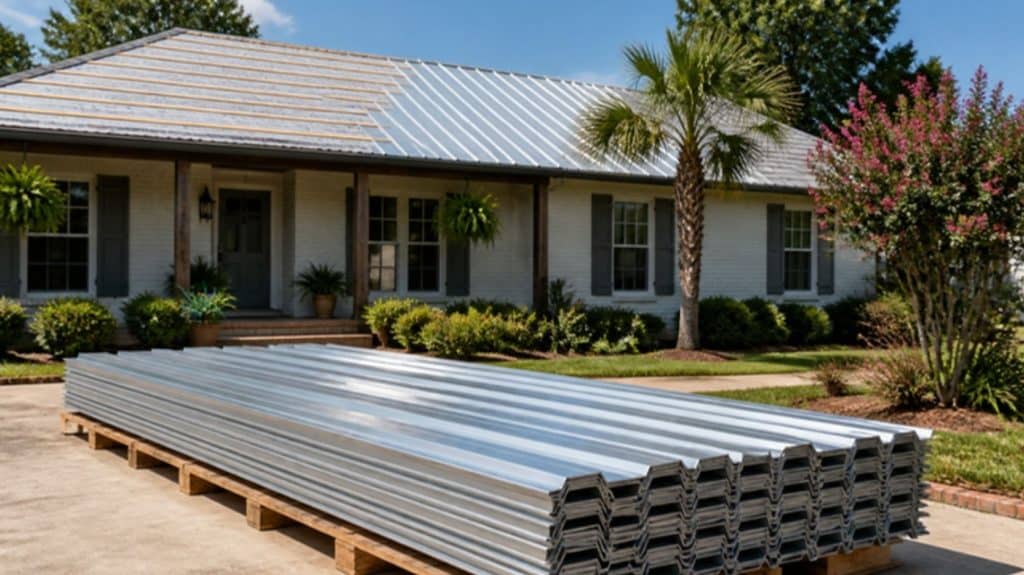
Metal roofing runs $5 to $16 per square foot installed, which works out to $7,500 to $40,000 for a typical house. That’s one of the widest price bands in roofing, and the reason is that “metal roof” describes about eight different products.
A corrugated steel panel and a standing seam zinc roof are both metal, and one costs four times the other. Below is how the price breaks down by profile, metal and gauge, plus the slope rules that decide whether metal is even an option. Our metal roof page covers what we install, and the TurnKey Roofers homepage shows the rest.
For a measured quote on your own roof, call (504) 732-0336 or use the contact page.
Key takeaways
- Metal costs $5 to $16 per square foot installed, against $3 to $6 for asphalt shingles.
- Profile matters more than brand. Corrugated is $5 to $12, metal shingles $6 to $14, standing seam $9 to $16.
- Labor alone is $400 to $800 per square, because a metal roof is a fabrication job as much as a roofing job.
- Most residential metal is 24 or 26 gauge, and the number goes down as the metal gets thicker.
- Aluminum is the material most recommended near the coast for its corrosion resistance. Weathering steel is not suitable for coastal use.
- Standing seam works down to a 1/4:12 slope, while metal shingles need 3:12 or steeper.
Metal roof cost by roof size
Metal is priced per square foot of roof area, not floor area. HomeGuide’s size table below uses the full $5 to $16 band, so a realistic quote for a specific product will land in a narrower slice of each row.
| Roof size (square feet) | Installed cost |
|---|---|
| 1,000 | $5,000 to $16,000 |
| 1,500 | $7,500 to $24,000 |
| 2,000 | $10,000 to $32,000 |
| 2,500 | $12,500 to $40,000 |
| 3,000 | $15,000 to $48,000 |
| 3,500 | $17,500 to $56,000 |
The national average lands at $23,800. Most contractors quote by the square, and one square covers 100 square feet.
Cost by panel profile
Profile is the first decision and it moves the price more than the metal does. These are HomeGuide’s installed figures.
| Profile | Material per square foot | Installed per square foot |
|---|---|---|
| Corrugated or sheet metal | $1 to $5 | $5 to $12 |
| Metal shingles | $3 to $6 | $6 to $14 |
| Standing seam | $4 to $8 | $9 to $16 |
Corrugated panels come in wavy, ribbed or 5-V crimp styles and install faster than standing seam. The tradeoff is exposed fasteners, which need more maintenance because every screw is a penetration sitting in the weather.
Standing seam hides the seams and the fasteners under the panel ribs, which makes a more watertight surface. Premium metals in standing seam push the range to $11 to $32 per square foot.
Cost by metal
Once you’ve picked a profile, the metal itself sets the rest. Prices below are per square, which is 100 square feet.
| Metal | Material per square | Installed per square |
|---|---|---|
| Galvanized steel | $100 to $500 | $500 to $1,300 |
| Galvalume | $100 to $450 | $500 to $1,300 |
| Weathering steel | $200 to $300 | $600 to $1,100 |
| Aluminum | $300 to $900 | $700 to $1,700 |
| Stone coated steel | $350 to $600 | $700 to $1,300 |
| Stainless steel | $550 to $1,300 | $1,000 to $2,100 |
| Zinc | $500 to $1,000 | $1,000 to $2,000 |
| Copper | $900 to $2,000 | $1,300 to $3,000 |
Galvalume is steel coated with an aluminum, zinc and silicon mixture, and it resists corrosion better than plain galvanized. HomeGuide notes it’s among the most popular choices in non-coastal areas specifically.
Gauge, and why the number runs backwards
Gauge describes thickness, and the number falls as the metal gets thicker. Thicker metal costs more, handles harder, and stands up better where weather is severe.
- 29 gauge, $1.00 to $3.00 per square foot. Small barns and sheds in mild climates.
- 26 gauge, $1.50 to $5.00. Residential roofs in mild to moderate climates.
- 24 gauge, $3.00 to $7.00. Residential and commercial roofs in severe weather regions.
- 22 gauge, $4.00 to $8.00. Commercial and high end residential.
Most residential metal roofing is 24 or 26 gauge. On the Gulf Coast the case for 24 is straightforward, and HomeGuide puts thicker gauge squarely in the severe weather column.
What else lands on the estimate
The panels are one line. These are the others, and a quote that omits them isn’t complete.
- Tear off. Removing the existing roof costs $1 to $3 per square foot, or $100 to $300 per square.
- Underlayment. Synthetic underlayment for metal runs $0.10 to $0.90 per square foot and is usually included in the replacement price.
- Decking. Replacing roof deck costs $2 to $5 per square foot, and nobody can price it until the old roof is off.
- Waste. Contractors typically add 10 to 15 percent to material on complex roofs to cover offcuts.
- Ventilation. Roof vent installation runs $200 to $700 per vent.
- Permits. HomeGuide puts roofing permits at $150 to $500, and most estimates include the fee.
Labor is the biggest single addition. HomeGuide puts metal roof labor at $400 to $800 per square, and standing seam takes more time and skill than corrugated does.
Slope decides whether metal works at all
Louisiana follows the 2021 International Residential Code, and Chapter 9 sets hard minimum slopes by product. This is the part that rules metal in or out before price enters the conversation.
- Standing seam systems are allowed down to 1/4 unit vertical in 12 horizontal, a 2 percent slope.
- Lapped, non soldered seam metal roofs with applied lap sealant need at least 1/2:12.
- The same lapped panels without lap sealant need 3:12.
- Metal roof shingles can’t go on slopes below 3:12 at all.
Wind resistance is tested and labeled. The code requires metal roof shingles on a solid deck to be tested to ASTM D3161, FM 4474, UL 580 or UL 1897, and to carry a label showing the classification. Ask for that label on the submittal rather than taking a wind number from a brochure.
Exposed fasteners against hidden ones
This is the choice that decides how much attention the roof wants over the next 20 years. HomeGuide puts exposed fastener systems at $500 to $1,200 per square installed and concealed fastener systems at $900 to $1,600.
Exposed fastener roofs have visible screws, clips or bolts holding the panels down. They cost less and go on faster, and they wear faster because each penetration sits out in the sun and rain with a rubber washer doing the sealing.
Concealed fastener systems tuck the fasteners under the panel, which makes a more watertight surface with less upkeep. On a house that sees driving rain from tropical systems, that difference is worth the premium more often than not.
Metal over an existing roof
There’s one path where a metal roof skips the tear off entirely, and it’s written into the code rather than being a contractor shortcut. Section R908.3.1 allows complete and separate roofing systems, standing seam among them, to go over an existing covering where they’re designed to transmit roof loads directly to the building’s structure and don’t rely on the old roof for support.
The limits still apply. A recover isn’t permitted where the existing roof is water soaked or too deteriorated to act as a base, where the existing covering is slate, clay, cement or asbestos cement tile, or where two or more applications are already up there.
Skipping the tear off saves the $100 to $300 per square removal cost. It also means nobody inspects the decking, so you’re betting on wood you can’t see. On an older New Orleans house that bet is worth thinking about twice.
Coastal choices in southeast Louisiana
Salt air changes the material shortlist. Aluminum is among the most recommended roofing materials in coastal regions because of its corrosion resistance, which is why it carries a higher material price than steel.
Weathering steel is the opposite case. HomeGuide states it isn’t suitable for tropical or coastal regions, because it needs alternating moist and dry cycles to form its protective rust layer. In a humid coastal climate it keeps rusting instead of stabilizing.
There’s a heat argument too. The EPA notes that metal shingles or tiles coated with reflective paint or surfaced with reflective granules qualify as steep slope cool roof products, and that buildings with cool roofs use less air conditioning. Our page on stone coated steel roofing covers one of the products that sits in that category, and the roofing types overview compares metal against the alternatives.
Frequently asked questions
Is it cheaper to put a metal roof or shingles?
Shingles, up front, in almost every case. HomeGuide puts asphalt at $3 to $6 per square foot installed against $5 to $16 for metal, so even budget corrugated steel starts near the top of the asphalt range. Metal makes its case on service life instead, at 30 to 80 plus years against 15 to 30 for asphalt.
How much does a metal roof cost for a 1000 square foot house?
A 1,000 square foot roof runs $5,000 to $16,000 installed. Note that a 1,000 square foot house has more than 1,000 square feet of roof once pitch and overhangs are counted, so measure the roof rather than the floor plan. A corrugated steel roof on that size sits nearer $5,000 to $12,000, while standing seam sits nearer $9,000 to $16,000.
How much does a 2000 sq ft metal roof cost?
HomeGuide puts a 2,000 square foot metal roof at $10,000 to $32,000 installed. The spread comes down to profile and metal: galvanized or galvalume steel at the bottom, aluminum in the middle, and copper or zinc at the top. Gauge, roof complexity and the amount of decking repair found on tear off move it within that band.
Do metal roofs need less maintenance than shingles?
Less, but not none, and it depends on the fastener system. Exposed fastener corrugated roofs need their screws and washers checked, since those penetrations wear faster than the panels do. Typical metal roof maintenance is removing rust, resealing loose seams and fasteners, and applying corrosion resistant coating.
Get a metal roof priced properly
A metal roof quote that doesn’t name the profile, the metal, the gauge and the fastener system isn’t a quote. Those four things account for most of the price difference between $5 and $16 per square foot.
We’ll measure the roof, tell you which products suit its slope, and put the numbers in writing. Call (504) 732-0336 or use the contact page.
Related reading
- Best Roofing Options for New Orleans’ Climate
- How Roofing Types Affect Noise Control Inside Your Home
- How New Roofing Materials Help Reduce Urban Heat in Cities
Sources
Common questions about working with us
Yes we do, we offer 50 year non pro-rated warranty and 10 year workmanship warranty. We also offer 15 year unlimited wind warranty even from a named storm.
Turnkey roof repair is a comprehensive service where the entire roof repair process is managed from start to finish by a single provider. This includes assessment, planning, execution, and final inspection.
The TurnKey process includes a thorough roof inspection, detailed project planning, sourcing of materials, execution of repairs, and a final inspection to ensure quality and client satisfaction.
The duration varies based on the extent of damage and the size of the project. A professional assessment will provide a more accurate timeline.
Look out for signs such as leaks, missing or damaged shingles, sagging areas, or visible water damage in your ceiling. If you’re unsure, a professional assessment is recommended.
We work across New Orleans and 13 more communities: Metairie, Kenner, Harahan, River Ridge, St. Rose, Gretna, LaPlace, Covington, Mandeville, Madisonville, Slidell, Hammond and Baton Rouge. Call 504-732-0336 and we’ll confirm we cover your street.
Yes. Our 15-year unlimited wind warranty applies even when the damage comes from a named storm. It sits alongside our 50-year non-prorated warranty and 10-year workmanship warranty.
It depends on the size and pitch of the roof, the material you choose, and whether any decking or flashing needs replacing. After a free roof inspection, we give you a plan and a quote. For a breakdown by material and roof size, read our guide to roof replacement cost in New Orleans.


