

How Many Days a Roof Replacement Takes From Tear Off to Cleanup
Most homeowners want two numbers before they sign anything: what it costs and how long the house will be a building site. The second one is easier to answer than people expect.
For a typical New Orleans house with asphalt shingles, the roof itself is a short job. TurnKey Roofers works to a dated schedule, and the paperwork around the work usually takes longer than the work.
For a schedule on your own roof, use the contact page or call (504) 732-0336.

Key takeaways
- HomeGuide reports roof replacement taking 1 to 8 days overall, depending on material, size, pitch and complexity.
- Asphalt shingle replacement runs 1 to 3 days, metal 1 to 5 days, and wooden shakes or slate 6 to 8 days.
- Rain, snow, heavy winds or temperatures below 40 degrees Fahrenheit will delay installation.
- New Orleans quotes 2 to 4 days to issue a residential re-roofing permit, and historic districts may take longer.
- The permit process requires 16 geotagged inspection photos across four stages of the installation.
- Steep pitches over 6:12 need extra safety precautions and more labour, which stretches the schedule.
The short answer by material
| Roof material | Time on site, per HomeGuide | What drives the variation |
|---|---|---|
| Asphalt shingles | 1 to 3 days | Roof size, pitch, number of penetrations |
| Metal | 1 to 5 days | Panel forming, flashing details, trim work |
| Wood shakes or slate | 6 to 8 days | Weight, piece-by-piece installation, structural checks |
| Any material, whole project | 1 to 8 days | Size, pitch, material and complexity together |
Those are HomeGuide’s national figures and they describe time on the roof, not the time from your first phone call. The full calendar runs longer once the estimate, the permit and material ordering are counted.
What happens on each day
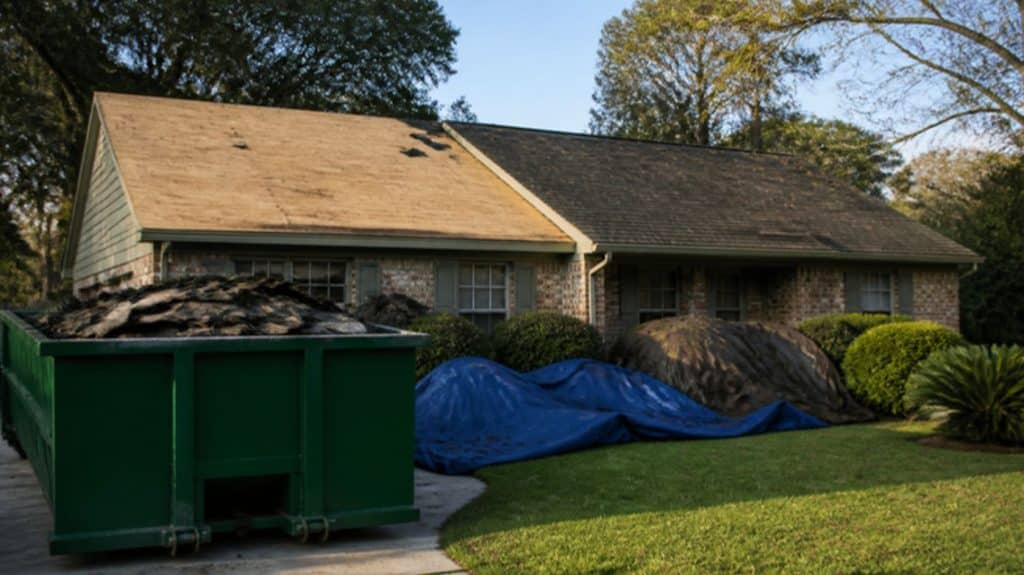
- Setup. Tarps and plywood go down over landscaping, walkways and anything below the eaves, and a skip or trailer gets positioned.
- Tear off. The old covering comes off down to the deck. HomeGuide prices this separately at $1 to $3 per square foot for shingles or metal, and $2 to $5 or more for heavier materials.
- Deck inspection and repair. Soft or rotted sheathing gets replaced, and this is the stage most likely to add unplanned time.
- Underlayment and edge metal. Drip edge at the eaves, underlayment over it, drip edge on the rakes over the underlayment, following the sequence LSU AgCenter sets out.
- Covering. Starter strip, then courses up the slope, with flashing woven in at every penetration as the work passes it.
- Ridge, cleanup and inspection. Ridge cap, a magnet sweep of the yard and driveway, and a walk-round with the homeowner.
On a straightforward asphalt re-roof, steps two through six can all fall inside two working days. Our roof replacement page describes the process in more detail.
What the permit adds in New Orleans
Since Ordinance 30,235 MCS, the city requires a separate residential re-roofing permit for any roof replacement affecting 50 percent or more on a single or two family home. Minor roofing work under 50 percent is exempt unless something else about the job requires a permit.
The city quotes a duration of 2 to 4 days to issue it, with a note that historic districts may require additional time. The base fee is $60, with an extra $30 for properties in the Historic District Landmarks Commission or Vieux Carré Commission areas.
Documentation happens during the work rather than after. The city requires 4 wide-angle geotagged photos from each direction at each of four stages, 16 in total: removal of the existing material, installation of the water intrusion resistant underlayment, installation of the drip edge and flashing, and installation of the shingles or metal panels.
A certificate of completion follows once the photos have been reviewed. Commercial properties, meaning three or more units or business uses, can’t use this permit and need a renovation permit instead.
What makes a job take longer
- Weather. HomeGuide lists rain or snow, heavy winds or temperatures below 40 degrees Fahrenheit as delaying installation. Along the Gulf Coast it’s the rain and the wind that matter.
- Pitch. Roofs with steep pitches over 6:12 require extra safety precautions and more labour.
- Complexity. HomeGuide lists complex roofs, multiple stories, skylights and chimneys as cost factors, and each of them is also a time factor.
- Layers. More existing layers means more tear-off, and most cities limit roofs to a maximum of two layers.
- Hidden decking damage. Nobody knows what the sheathing looks like until the covering is off.
- Historic district review. New Orleans notes properties in HDLC or VCC areas require additional review before the permit is issued.
- Extras. Skylights, new gutters, soffit and fascia repair or ventilation changes all add scope.
The calendar before the crew shows up
Time on the roof is only part of it. The stretch between deciding to replace and seeing a truck outside is usually longer than the installation itself.
- Estimates. HomeGuide suggests getting at least three written estimates from licensed contractors, which takes a week or two to line up.
- Product selection. Colour, shingle grade and any upgrades to underlayment or ventilation need deciding before material is ordered.
- Permit. The city quotes 2 to 4 days, plus additional review time in a historic district.
- Material delivery. Stock colours are usually quick, and anything special order is not.
- Scheduling. The queue lengthens sharply after a named storm moves through the region.
Ask where you sit in that queue when you accept a quote. A contractor who can tell you the week is worth more than one who says soon.
Why weather governs the pace here
A roof can only be opened up as far as it can be closed back in the same day. That’s the rule that decides how much tear-off happens on a morning with rain in the forecast.
HomeGuide names rain, heavy wind and temperatures below 40 degrees Fahrenheit as delays. In this climate the temperature threshold rarely bites, and the afternoon thunderstorm does.
Wind matters for a second reason. Loose underlayment and stacked shingle bundles behave badly in a gust, and LSU AgCenter notes that high-wind areas need underlayment fastened with corrosion resistant fasteners set 36 inches apart along the overlap.
A crew that stops early on a threatening afternoon isn’t wasting your time. They’re avoiding the situation where an open deck meets a downpour.
Living in the house while it happens
You can normally stay. The work is outside, the power stays on, and the crew works daylight hours.
It is loud. Tear off is the worst of it, and a nail gun directly above a room carries straight through the ceiling.
Plan around the noise rather than around the crew. Anyone working from home, sleeping in the day or keeping a baby on a nap schedule should arrange somewhere else to be for the tear-off day.
Vibration shakes things loose. Take pictures off walls in upstairs rooms, secure anything on high shelves and expect a light dusting in the attic.
Access changes for a day or two. The driveway usually holds a skip or a trailer, and the area under the eaves becomes a drop zone that nobody should be walking through.
Cleanup is the part worth asking about specifically. A magnet sweep of the driveway, the lawn and the street should happen at the end of each working day rather than only at the end of the job, because a nail in a tyre a week later is nobody’s idea of a finished project.
Getting ready before the crew arrives
- Move vehicles out of the driveway and off the street in front of the house.
- Clear the perimeter: pots, furniture, grills, hoses and anything fragile within about ten feet of the walls.
- Cover or move items stored in the attic, since debris comes through the sheathing joints during tear off.
- Take down wall hangings and mirrors in upstairs rooms.
- Keep pets indoors and away from the work area for the whole job.
- Agree where the skip goes and where materials will be stacked.
- Confirm the crew’s access to power and water, and where they’ll park.
Before you sign, check the schedule and the licence
An estimate should carry a start date, a working-day count and what happens if weather pushes it. It should also name who pulls the permit.
Check the licensing while you’re at it. Louisiana requires a Residential Roofing or Residential Construction classification for residential roofing work with a project value of $7,500 or more, effective August 1, 2026.
HomeGuide also suggests getting at least three written estimates, avoiding the cheapest quote where quality may suffer, and not paying in full up front. Our post on questions to ask before roof work begins covers the rest.
Frequently asked questions
Can you stay in your house while the roof is being replaced?
Yes, in almost every case. The work happens outside, utilities stay connected, and crews work daylight hours, so the practical issue is noise and vibration rather than habitability. The exception is where structural decking work opens up a large area, or where somebody in the house genuinely can’t be around sustained hammering, in which case plan to be elsewhere for the tear-off and installation days.
How disruptive is replacing a roof?
Noisy and dusty for a short period, and largely over once the covering is back on. Expect debris in the attic, vibration that can shake pictures off upstairs walls, restricted driveway access and a skip parked at the property for the duration. HomeGuide’s timelines put an asphalt shingle roof at 1 to 3 days, which is the realistic window for most New Orleans houses.
Can a roof be replaced in one day?
Sometimes, on a small, simple, single-layer asphalt roof with a decent-sized crew and good weather. HomeGuide’s range for asphalt shingle replacement starts at 1 day, so it’s within the normal band rather than an outlier. What rules it out is a steep pitch over 6:12, multiple existing layers, lots of penetrations, or decking that turns out to need replacing once the old covering is off.
How long does the whole process take from first call to finished
Budget a few weeks rather than a few days. The estimate and material selection take some time, New Orleans quotes 2 to 4 days to issue the re-roofing permit with longer in historic districts, and material ordering and scheduling sit on top of that. The roof work itself is still 1 to 3 days for asphalt shingles, per HomeGuide’s figures.
Get a dated schedule, not a vague one
A roofing estimate that won’t commit to a start date and a working-day count is an estimate you can’t plan around. We put both in writing along with the permit and inspection steps.
Call (504) 732-0336 for a free estimate, or read how we run the work on our roof installation page.
Related reading
- How to Manage a Roof Upgrade Without Interrupting Your Tenants
- How to Tell If Your Roofing Job Was Done Poorly
Sources
- HomeGuide, Roof Replacement Cost (2026)
- City of New Orleans, Residential Re-Roofing Permit
- Louisiana State Licensing Board for Contractors, Changes to Contractor Licensing Laws
- LSU AgCenter, Roofing to Resist Wind and Rain Damage
- LSU AgCenter, Consumer’s Guide to Code-Compliant Roofing Installations
Common questions about working with us
Yes we do, we offer 50 year non pro-rated warranty and 10 year workmanship warranty. We also offer 15 year unlimited wind warranty even from a named storm.
Turnkey roof repair is a comprehensive service where the entire roof repair process is managed from start to finish by a single provider. This includes assessment, planning, execution, and final inspection.
The TurnKey process includes a thorough roof inspection, detailed project planning, sourcing of materials, execution of repairs, and a final inspection to ensure quality and client satisfaction.
The duration varies based on the extent of damage and the size of the project. A professional assessment will provide a more accurate timeline.
Look out for signs such as leaks, missing or damaged shingles, sagging areas, or visible water damage in your ceiling. If you’re unsure, a professional assessment is recommended.
We work across New Orleans and 13 more communities: Metairie, Kenner, Harahan, River Ridge, St. Rose, Gretna, LaPlace, Covington, Mandeville, Madisonville, Slidell, Hammond and Baton Rouge. Call 504-732-0336 and we’ll confirm we cover your street.
Yes. Our 15-year unlimited wind warranty applies even when the damage comes from a named storm. It sits alongside our 50-year non-prorated warranty and 10-year workmanship warranty.
It depends on the size and pitch of the roof, the material you choose, and whether any decking or flashing needs replacing. After a free roof inspection, we give you a plan and a quote. For a breakdown by material and roof size, read our guide to roof replacement cost in New Orleans.


